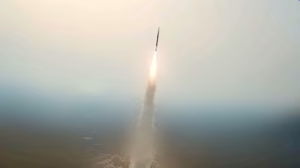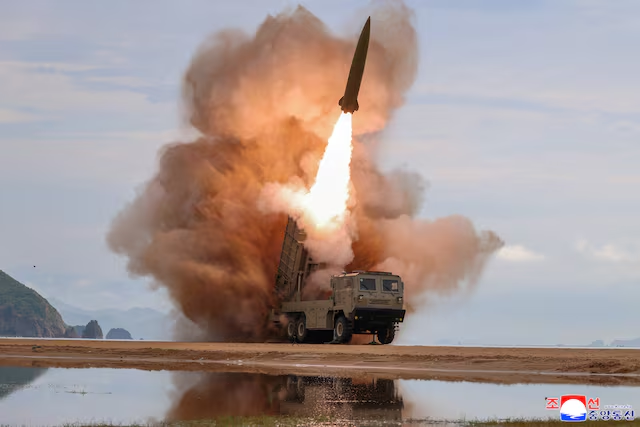
SEOUL — North Korea fired a ballistic missile into waters off the Korean Peninsula’s eastern coast on Wednesday, South Korean and Japanese authorities said, in the latest launch ahead of planned joint military exercises between Seoul and Washington.
South Korea’s Joint Chiefs of Staff said the missile was launched from the Wonsan area at about 6 a.m. local time. The projectile travelled approximately 700 kilometres before falling into the sea, according to South Korean and Japanese defence authorities.
The launch came just five days before the United States and South Korea are due to begin their annual Ulchi Freedom Shield exercises, scheduled for August 17 to 27.
North Korea has long condemned the drills, describing them as preparations for an attack, while Seoul and Washington maintain that the exercises are defensive and designed to strengthen their ability to respond to security threats.
Wednesday’s launch was the second ballistic missile firing from the Wonsan area in less than a week. South Korean authorities said North Korea conducted another launch from the same location on August 6.
Missile type remains unclear
South Korea’s military has not yet classified Wednesday’s weapon as a short-range ballistic missile and said further analysis was under way.
The missile’s reported range, trajectory and launch location have prompted speculation among analysts about the type of weapon tested.
Hong Min, a senior researcher at the Korea Institute for National Unification in Seoul, said the missile could potentially have been a hypersonic weapon, although other possibilities, including a submarine-launched missile, remained open.
He also said the launch may have formed part of North Korea’s ongoing weapons development programme, but its timing could have been politically significant.
“Even if it was a test of a weapon under development, choosing when to conduct it requires a political decision,” Hong said.
South Korean assessments indicate that Wednesday’s launch was North Korea’s 11th suspected ballistic missile test of 2026. The country has also tested short-range missiles, artillery rockets and other tactical weapons during the year.
Seoul and Tokyo condemn launch
South Korea and Japan both condemned the latest test.
South Korea’s National Security Office held an emergency meeting and called on Pyongyang to stop missile launches that violate United Nations Security Council resolutions.
The South Korean military said it remained prepared to respond to any further provocation through its combined defence posture with the United States.
Japan also lodged a protest through diplomatic channels.
Japanese Defence Minister Shinjiro Koizumi said Tokyo had strongly condemned the launch and formally raised its objection with North Korea.
The US Indo-Pacific Command said it was consulting with South Korea, Japan and other allies. Its initial assessment was that the missile launch did not pose an immediate threat to US personnel, territory or its allies.
Tensions rise ahead of military exercises
The latest launch adds to already heightened tensions on the Korean Peninsula as Seoul and Washington prepare for their annual military exercises.
North Korea has repeatedly opposed the drills and has argued that the exercises demonstrate hostile intentions by the United States and South Korea.
Pyongyang has also criticised South Korea’s plans to develop nuclear-powered submarines, describing the move as a threat to regional stability.
A North Korean Foreign Ministry official said Seoul’s military plans represented a serious challenge to the North’s security and argued that Pyongyang needed the ability to respond to what it considers hostile military actions.
North Korea’s state-run Korean Central News Agency also accused Japan of moving towards nuclear armament under the cover of its civilian nuclear programme, citing recent discussions among Japanese politicians about nuclear weapons.
North Korean weapons linked to wider conflict
North Korea’s missile programme has also attracted international attention because of its growing military cooperation with Russia.
Ukrainian President Volodymyr Zelenskyy said on Tuesday that Russia had used North Korean ballistic missiles during an attack on the southeastern Ukrainian city of Zaporizhzhia that killed seven workers at a steel plant.
The latest North Korean launch therefore comes amid wider concerns about Pyongyang’s development and transfer of military capabilities, as well as its increasingly close strategic relationship with Moscow.
For now, South Korean authorities are continuing to analyse Wednesday’s missile to determine its precise type and characteristics, while military forces in the region remain on heightened alert ahead of the US-South Korea exercises.